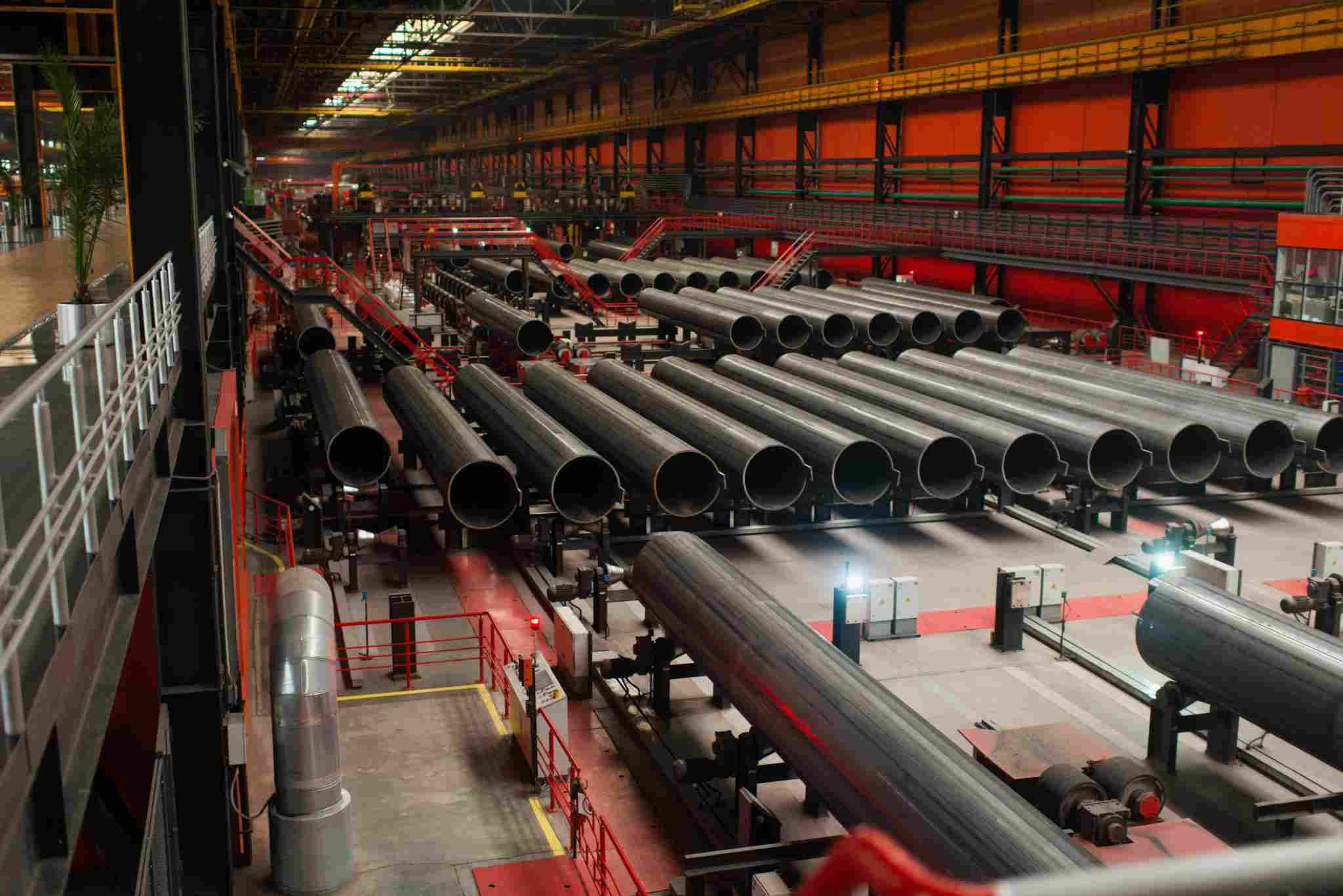
Steellogy manufactures industrial knives for metal processing, including shear blades for plate and sheet cutting, circular slitting knives for coil processing and trimming blades for strip finishing lines. Steel, aluminium and copper place different demands on grade and hardness; both are agreed per order and stated in the confirmation. The knives are made in our own facility in Poland.
Shear Blades for Metal Cutting
Metal shear blades are heavy-duty industrial knives used to cut steel plate and sheet on hydraulic and mechanical guillotine shears. The blade must hold a straight, sharp edge across its full length; the first end-of-life signal is rising burr height on the cut edge. Steellogy produces shear blades from grades selected by duty — shock-resisting steels of the 6CrW2Si class for cold shearing, D2-class for medium plate and non-ferrous, H13 for hot shearing — with hardness tuned to the duty: supplier guidance gives approximate ranges of HRC 50–55 for impact-heavy work, 56–60 for general sheet, and 60–65 for thin precision cutting. Length, hole pattern and edge count are manufactured to the buyer-approved drawing; where the design allows, blades are ground with four usable edges.
Our metal shear blades are compatible with shearing machines from manufacturers including Amada, TRUMPF, LVD, HACO, Baykal, Durma and Ermaksan. Custom dimensions and steel grades are matched to the material you cut.
Circular Slitting Knives for Coil Processing
Circular slitting knives are precision-ground round blades used in coil slitting lines to cut wide coil into narrower strips, mounted with spacers on arbors. Blade condition directly determines strip edge quality, burr formation and dimensional accuracy. Steellogy manufactures slitting knives from D2 / 1.2379, HSS M2 and tungsten carbide; carbide is commonly used for silicon steel and precision slitting of thin stainless steel. Knives and spacers must match the arbor bore and tolerance class, so we grind them to the drawing and quote complete sets rather than individual components. Similar precision-ground circular blade technology is used in our industrial knives for paper cutting.
Trimming and Side-Trimmer Blades
Trimming blades and side-trimmer knives are used in steel mills and processing centers to trim strip edges to final width, often paired with scrap choppers. They see the full range of processed grades, from mild carbon steel to high-strength stainless and silicon steels — so the knife grade and heat treatment are chosen for the specific metal being cut, not for the machine name. Send the strip grade, thickness and temper with the enquiry.
Steel Grades for Metal Cutting Knives
For slitting mild and medium-carbon steels, D2 / 1.2379 is the common grade, with supplier-reported hardness bands around HRC 58–65 depending on duty. For stainless and high-strength alloys, HSS grades (M2, M42) add hot hardness and edge retention. Tungsten carbide delivers the highest wear resistance for high-volume slitting. One caution from our materials work: Chinese Cr12MoV is not a direct D2 equivalent — it carries less Mo and V — so substitutions need a composition and heat-treatment review, not just a name match. For a broader overview, see our guide to selecting industrial knives — the same metallurgical principles apply across sectors.
Why Choose Steellogy for Metal Cutting Knives
Steellogy manufactures industrial knives for metal processing in Europe. We supply shear blades, slitting knives and trimming blades for lines from machine builders such as Fagor Arrasate, Braner, Red Bud Industries, Amada and LVD. Material, hardness and acceptance requirements are agreed for each order. If material-documentation, hardness-measurement or dimensional-inspection requirements are included in the RFQ, their availability and scope are confirmed in the quotation. For supplier evaluation, see our OEM and aftermarket analysis. Contact Steellogy for a quotation.